Saturday, September 1, 2012

A Storm Can Have an Effect

It stormed last night and cooled things off.

This morning, when we walked later than usual, it was very comfortable, but verging on more storm. We took a shorter route and stayed closer to home. Asia avoids wind, thunder and lightning, and rain.

At home, when things outside become raucous, Asia will go to the bedroom and hunker down there until it becomes calm again. The east side of the house is more dynamic in most storms. Many winds howl out of the east, where the mountains are, sweeping down through the foothills, where our house is, to the valley below.

We have a flue where we could have a fireplace or stovepipe on the east side of the house. It is covered on the roof with sheet metal, and during a wind storm the erratic pressure expands and contracts it, making thunderous sounds like a percussionist beating timpani. This drives Moochie — Moochie is Asia's nickname — west, to the bedroom.

Actually, Asia wanted to walk further, up the long hill to the approaching a half-million dollar houses on the northern bench that overlooks South Weber. By the time we would have made that turn to go west instead of east, the sky began to rumble and a few droplets of rain fell. Asia will balk and tugged in the direction she wants to go. She knows how to put on the brakes, planting her paws and locking her legs. She is quite strong and insistent. I am patient with her, waiting a few minutes, then talking gently and tugging her along, being careful she doesn't slip her way out of her harness.

By the time we got back to 3700 N., she was ready to get back home. The volume of the thunder combined with the frequency of raindrops contained more persuasive effect than my earlier attempts to tug and coax her.

The procedure on reaching the house doesn't very much. First of all, I dump whatever I have collected in plastic bags from Walmart in the outside garbage can. We then climb the stairs and go in the door. Asia pauses at the bottom of the stairs that go up to the living area from the living room we have entered. Sometimes she pauses on the stairs. Her pause is necessary so I can remove her leash. She then proceeds up the stairs, opens the doggie gate there and goes into the kitchen to get a drink. Sometimes if someone is up there, she might get distracted.

I put her leash away, empty my pockets of any other plastic bags I used to pick up after her and put them in the closet along with the leash.

I don't think there can be any question but that over time in Western culture women have fared better and better the more they stood up for themselves and others took their cause seriously and helped them.

a good turn of word in the lathe of literature

This is a review of TRUCK, A LOVE STORY by Michael Perry.

Don't you think the title of this book TRUCK, A LOVE STORY seems a little hokey, maybe even manipulative? It's as if its author — or more likely, the book's editor/publisher, who most often does the naming — wanted to broaden the book's market appeal. How many women would read a book titled TRUCK? How many men would read A LOVE STORY (setting aside that old romance novel by Eric Segal, which was made into a movie)? However, I guess it could be said that this particular book appeals to broader audiences than those just enamored of a particular vehicle or of touchy-feely stories of romance and love.

Well, all of that is beside the point. The book is good, worth reading whether you're a male or female or somewhere in between. Michael Perry writes well, even if it seems sometimes he has too much on his mind. I happened to read this with a book club comprised primarily of women. They generally outnumber the men in the group three or four to one. Many of the books we read could be considered more or less feminine oriented and sometimes I've even heard the women themselves utilize the term chick lit. Because they outnumber the men so far this is the dynamic we men in the group have to live with. But truthfully, we cover a broad swath of interesting fiction and nonfiction, mostly fiction, which brings me to this book.

Is TRUCK, A LOVE STORY fiction or nonfiction? It reads like a memoir, but I never did really see anywhere where it claims to be nonfiction. Perhaps, Michael Perry realizes that imaginations always figure into memories and experiences anyway. (The author after all writes, "Fortunately, the eye is an organ capable of deception. In collusion with the brain, it convinces you to ignore what you see — or don't see.) Or perhaps I just missed where it says what it is.

This is a slow reading piece, a work you want to take your time with, a book you might start reading in bed at night if you want to go to sleep. Now I don't mean by that to say that it is boring or anything derogatory. But don't compare it with today's fast-paced fare, which seems targeted at hyperactivity disordered readers. This isn't calculated to keep you on the edge of your seat, shrieking, or covering your eyes in order to cope. Instead it'll make you want to languish like you are in the Bahamas on the beach with unlimited time and plenty of food and drink by your side with the most charming companion.

Where does a truck come in to all of this? Perry is restoring an old International Harvester truck with his brother. The restoration ticks off the time in the book. Perry's attitude is communicated in this manner: "In 1951, a man bought a pickup truck because he needed to blow things up and move them. Things like bricks and bags of feed. Somewhere along the line trendsetters and marketers got involved, and now we buy pickups — big, horse-powered, overbuilt, wide-assed, comfortable pickups — so that we may stick our key in the ignition of an icon, fire up an image, and drive off in a cloud of connotations. I have no room to talk. I long to get my International running in part so I can drive down roads that no longer exist."

Who is Perry? He describes himself: "At thirty-eight, I'm still a few follicles from a Category Cue Ball." This is one of his obsessions, besides his truck. He says, "I was raised in a fundamentalist Christian sect that not only frowned on vanity but viewed long hair on a man as sinful." He also describes himself as follows: "No matter our vocation, we so often find ourselves living life as a form of triage. I need more time with the dirt, the sense of the soil with its plenty." So gardening is another of his — I don't want to say obsessions — passions.

Family is another honored subject for the author. Speaking of his grandmother, he says "this time she raised five children of her own and took in another twenty-eight foster children. She did her baking with a .22 rifle at hand and was known to step away from the stove to snipe feral cats and once an incautious woodchuck."

And what of the love story part of the title? Well, there is Anneliese. But I can't say more without spoiling it for you, so I'll shut up and just recommend that you pick up the book, especially if you appreciate a good turn of word in the lathe of literature. If you like anecdotes stacked within the framework of car restoration and raising turnips while discovering a love interest, then find a beach in the South Pacific or Caribbean and languish away with TRUCK, A LOVE STORY in hand.

Friday, August 31, 2012

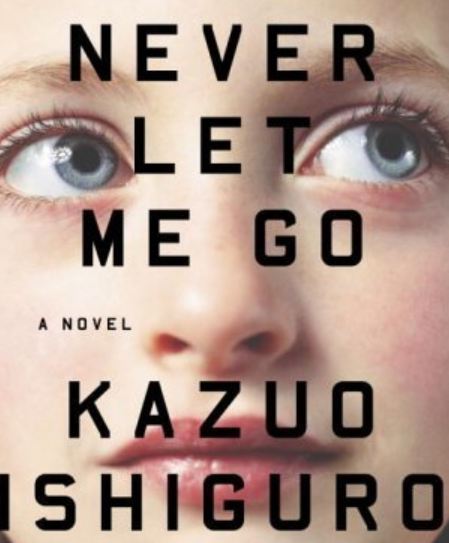
This is a review of NEVER LET ME GO by Kazuo Ishiguro.

I've been debating whether or not I should do this review. There are some awesome ones already. What can I add? Probably nothing.

I read NEVER LET ME GO as a consequence of belonging to a book club that meets monthly at a local Barnes & Noble store. My wife --- we've been married forty-one years --- recommended it to the group. My wife's been recently reading extensively --- not that she hasn't always --- but more so now because she has chronic cancer. The malignancy, and her treatments for it, keep her down. She can't do the physical activities she used to, so she spends time in less intensive physical activities, like reading. So whereas she used to get a daily physical workout, now her mind gets an extra rigorous one.

My wife found this list: the 1001 novels you should read before you die. This book was the first one on it. She hadn't read it, so she did some research, found data indicating it had been awarded various prizes, given much merit, and had favorable reviews from people on Goodreads, Amazon, and the like. So she recommended that the group read it. Among other suggestions by others, her recommendation won out.

I'm very glad we read it. It is well written, thought-provoking, and, to me, haunting. It is a treatise on morality and ethics blended into a tender, moving, and heartrending story. It was subtly done, not at all jarring or didactic. It seemed kind of like adding exactly the right amount of garlic to a roasting chicken, one that once cooked tastes scrumptious so you want your fill, but you're prevented from doing so.

The novel presents the story of that one wish --- never, as a human being, to be let go of --- which is quite universal. I think everyone wishes to have someone in life who will stick with them to the end, who will always hang on and hang out with them. I remember easily it's main characters: TOMMY D., RUTH, and KATHY H.

KATHY H. is the novel's narrator and protagonist. She reminisces about her youth, growing up in an institution, Hailsham --- a sham of an institution. For Hailsham imposes, we learn as we read through the novel, through subtle manipulation, the ultimate hell upon its occupants. That they, as human clones, are considered inferior to those who are not cloned. They must accept the responsibility to sacrifice themselves, their very lives, as, perhaps, for a while, "carers", and, ultimately, as "donors" by giving up needed vital organs --- their hearts, their lungs, their livers, etc. --- to humans who are not cloned. So Kathy H. as a young girl and adolescent interacts at Hailsham with her friends, Ruth and Tommy D., who then ultimately remain with her beyond Hailsham. In essence, it is Kathy H. who never lets Tommy D. and Ruth go.

Ishiguro nicely sketches out these three characters with unique features and intertwines them. While some in the group found the premise unrealistic, in my situation I found it compelling, thought-provoking, moving.

REDSHIRTS: A NOVEL WITH THREE CODAS by John Scalzi

Fun, but it could've been funner; funny, but it shouldn't have been so funny.

I graduated from high school in 1966. So I was pretty young when the original Star Trek television series played out. Sometimes I feel I'm just as young and naïve now.

This science fiction novel depended upon knowledge of the series, the fact that crewmembers unimportant to the continuing television saga got killed off in dramatic ways in the Enterprise's weekly exploitations. Scalzi plays on that "flaw" and builds his story from there.

So the main dynamic is set in the future with a spaceship named Intrepid and its "secondary" characters. The main characters of the novel, those secondary characters, figure out that essentially the same dynamic is happening to them.

Satire raises its head for savvy readers. Characterization is wanting. The dialogue seemed unnecessarily strained. The narrative focuses on the underlying mechanics and physicality of the scenario. The codas that follow the basic narrative play stronger, addressing such issues as life, choice, duty.

Where's my mother — in heaven?


Asia and I took a walk.

That's nothing new. It's mostly Asia's fault we go. She begs me; I resist, but I'm weak. I always have been susceptible to more gentle persuasion, muzzle nudging and kissing my hand with her wet nose.

We go out these days in the summertime two times, in the morning, not too early, and in the evening, when things have cooled off. Sometimes I try to keep us in the shade when it's particularly hot. There've been times when Asia finds the shade and makes us stop. Sometimes, she leaves me in the sun. She doesn't, however, usually lie down, but I wouldn't put it past her.

It's harder for me to go in the evening. It's tough to get up and move, not necessarily because I've wasted all my energy doing this or that physical feat during the day, but I guess I've mostly used what energy an old person in my poor shape and challenged health has.

We have our routes, the dog and I. However, they can always vary — usually they do in some respect. Tonight out the door and down the steps, we headed left, east, toward the mountains. We only passed two houses before the street turned and headed south. Usually, we continue in that mode, going south, until the street turns again and goes west. This evening, however, we turned on a street that intersects the street we were on and went west prematurely from our usual route.

Anyway, it's Friday night. Some Friday nights the streets are busy. Other Friday nights they are not. Tonight, earlier, there had been harsh winds and some showers. It was cooler, which you would think would bring out the masses, but it didn't. There weren't a lot of people out and about. Even the kids — especially the one little girl who's about three or four and always runs toward us shouting "Can I pet that dog? Can I pet that dog?" — weren't out tonight.

Sometimes I find myself wondering what people are doing. Fridays seem like a good day to go out to eat, to go to the mall, to go to a concert or the movie. Maybe that accounted for fewer people being out tonight.

Anyway, I want to attempt to make more frequent entries on my blog here. I'm writing the last few pages of my latest book, which was inspired by the Wikipedia controversies, the notion of privacy, and notions of surveillance and torture. It will need some revision, perhaps considerable, and whatnot, but I've been thinking about what I want to write about next. Women. Well, more than that, women's rights.

Now it might seem ill advised for a man — using the terminology liberally — to want to write about women's rights. The argument could be, shouldn't women write about that subject and take care of it, not men. I'm all for that, but I got to thinking. As a faithful man, I got to thinking about Heavenly Father and wondering why had I haven't ever seriously asked where is my Heavenly Mother? Seriously, why haven't I seriously considered that question?

So that's it.

Saturday, June 2, 2012

THE SCHOLAR OF MOAB

This is a novel to Peck at. Peckishly, perhaps. To cluck at, to cock a doodle do to.


Compiled by a Redactor, who is in a way, its Nick Carraway or Scout Finch, THE SCHOLAR OF MOAB is not the type of fiction that you want to wolf down. Savoring it is certainly the preferred method of consumption. In fact, as you try to digest it, you may want to eat gravel for your gizzard to make sure everything you've pecked up comes out ground down to a movable mass. You don't want it to get stuck in there. I suggest you consume yourself some redrock for that.

The place to get your redrock is at Arches National Park, known for its multitude of natural sandstone arches --- something like 2,000 of them. It's a beautiful place. Arches is also, as I understand it, the home of Suelo, a guy who advocates living without money. Google Suelo and see what I mean. How can you beat that? The Arches National Park is located just outside of Moab, Utah, a quirky place on its own, which general area is the fitting general setting of THE SCHOLAR OF MOAB. Visit or vacation there, preferably, in the spring time or the late fall.

That area's where protagonist, Hyrum Thayne, the scholar of Moab, lives with his devout, sometimes clueless, practicing Mormon wife, Sarah. In the surrounding vicinity resides the very capable --- Is she cagey or crazy or both? --- poet, Dora Tanner. Tanner's poetic verse has been apparently quite enticing, you might say, to Hyrum. Read the book and you'll find out how. You'll also find out what makes Hyrum so enticing, not necessarily in the way Dora has been enticed. Let me just say this: Hyrum was hilarious. Dora describes Hyrum as "affectionate, passionate, caring, independent, brave, lovely, cunning, honest, blind, confused, visionary, thoughtful, ardent, worried, gentle, god-fearing, genteel, bright, exuberant, shrewd, Mormon, handsome, puppyish, deceptive, thankful, fresh, naïve, pagan, scholarly." That pretty much sums him up pretty well. Dora says of herself that she is a Wiccan, has agnostic leanings, might be considered by Hyrum as a "Jack Mormon." She says they never talk about religion but "it seems to haunt" their "conversation beneath the surface of things in telling ways."

The Moab and the La Sal Mountains area are also where the conjoined Babcock twins, William and Edward --- moderated by Marcel --- cowboyed in their younger years. The narrative sketches out their history, including their education, their exploits and professions, and the difficulties of living with a brother slipping into dementia.

The comedian, George Carlin, as I recall, became discouraged and depressed from the unequal treatment given UFO believers compared to religious believers by the media. He observed that media moguls termed UFO believers "buffs" to relegate them to mere hobbyists and enthusiasts. He thought their disparaging characterization by the media, given a universe comprised of trillions and trillions of stars and multitudes of possible planets suitable for habitation, was untenable when compared to the deference given to believers in supreme beings. This novel made me wonder if its BYU-evolutionary-ecologist-professor author didn't read him some Carlin, too. Maybe gain some inspiration there? It's just a thought.

This book is a pastiche of fun, pain, and entertainment. There is plenty of seed on the ground to Peck up and digest. Most of all, I found it unique and compelling. I recommend you read it and see for yourself and let me know.

Sunday, May 6, 2012

A Dirty Job


DIRT, by David Vann, made me want to take a shower and an antidepressant. And I'm not a depressive. I needed to wash it off and purge it from my system, physically and mentally. For me, it was difficult to get through and to be done with.

It is that bad.

And you know what? I think it was intended to be so. In that respect it was a success.

Why do I think such terrible things about DIRT?

Because its title characterizes it. It is about people who are dirty, filthy, and squalid. Its story is soiled, like someone defecating, and at its end, it's ready to bury the fecal material and you hope it's digger will fall in, too. As a novel, it doesn't have a story arc in the conventional sense. It lacks a valid protagonist and gives voice throughout to a flatulent pro-antagonist, who spouts New Age philosophy and practices. All of its characters are corrupt, contemptible, and turbid, or incompetent.

Yet, as a work of fiction, it is well written and executed --- pun intended.

It's setting --- in a California nut orchard --- makes obvious that its characters are wacko. They certainly live up to it.

Galen is the twenty-two-year-old son of an insecure, manipulative mother, Susie Q. His mother is doing everything possible to prevent Galen from growing up and becoming independent, yet she herself relies on the resources of her institutionalized mother, who has dementia. Other characters include Galen's Aunt Helen, who apparently also is dependent on her mother and hates her sister. She is, also, a loser. And then there is Helen's seventeen-year-old daughter, Jennifer, a seemingly independent, promiscuous spitfire and opportunist. She is the only character, for me, whose soil may be somewhat fertile.

Normally, Galen would be the protagonist, but he's not up to the job in the novel, even though apparently he can get it up. He doesn't have any of the characteristics of a hero. He isn't endowed with courage or strength or celebrated for bold exploits. It's pretty much the opposite: he is a coward who is weak and timid. What twenty-two-year-old man with any moxie sticks around for the kind of squalor his mother dishes out? So instead Galen takes the role as the villain. He does a good job of it.

So a protagonist in DIRT is absent or nebulous --- maybe it's some "principle of philosophy" or "and idea about the contamination of generational family dysfunction and suicide." To tell you the truth, I don't know what it is. But I will say this, the novel makes me think. It has that much going for it.

Read it, but don't let it soil you.